The Red Cross

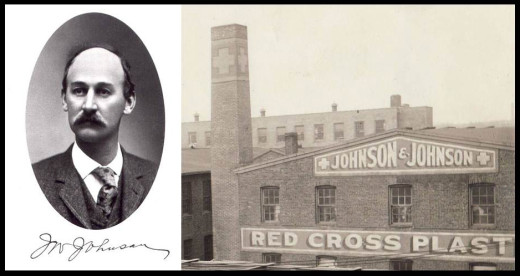
A lot of people are interested in the connection between Johnson & Johnson, the Red Cross symbol, and the American Red Cross right now, so here’s some background on Johnson & Johnson and the Red Cross trademark.  The use of the Red Cross trademark by Johnson & Johnson on its products actually predates the Congressional charter of the American Red Cross by thirteen years.  Johnson & Johnson has used the Red Cross symbol since 1887 on products such as sterile gauze, dressings and cotton, sterile catgut sutures, adhesive plasters, first aid products, a variety of medicated plasters and a large number of other products. 

Early Cotton Products, 1800s

Early Cotton Products Circa 1887 Using Red Cross Trademark

Historic Suture Products

 Early Sutures and Ligatures using Red Cross Trademark 


 Modern Methods of Antiseptic Wound Treatment, 1888

Cover of 1888 MODERN METHODS OF ANTISEPTIC WOUND TREATMENT


The Red Cross symbol, which came to identify many of the Company’s products, had become a valued trademark and a symbol of the products made by Johnson & Johnson. 


 Clara Barton, Founder of the American Red Cross

Clara Barton

The American National Red Cross was formed in the early 1880s by Clara Barton and was trying to get official recognition.  As a volunteer nurse, Barton had provided battlefield medical care to soldiers during the Civil War and had become involved with the International Committee of the Red Cross, leading her to found the American branch.  The organization received a Congressional charter in 1900 that officially recognized the group and mandated it to fulfill the provisions of the Geneva Convention by giving aid to victims of war and natural disasters.  Here’s a history of the American Red Cross

One of the requirements of signatories to the Geneva Convention was to protect the Red Cross insignia.  The U.S. had signed and approved the Geneva Convention in 1882, but the American Red Cross did not receive its first charter officially recognizing the organization until 1900.  The Congressional charter establishing the American Red Cross granted the ARC exclusive rights to use the Red Cross symbol.  The charter and an accompanying 1905 criminal statute allowed companies already using the symbol to continue using it. 

 Red Cross Toothache Plasters

Red Cross Toothache Plasters

Before the Congressional charter in 1900, the Red Cross symbol was just a trademark in the U.S.  During that time, there were many products that used the Red Cross symbol as a trademark, such as Red Cross Cigars, Red Cross Whiskey, Red Cross Playing Cards, Red Cross Washing Machines, Red Cross Stoves, Red Cross Churns, Red Cross Dog Collars and Red Cross Soap. 

In 1895, as a contingency plan, Robert Wood Johnson the first and Fred Kilmer had started discussions with Clara Barton about the use of the Red Cross symbol.  The Johnson brothers asserted that they had established the right to use the trademark they had been using for eight years.  As a result, after a number of meetings, an agreement was signed between Johnson & Johnson and the American National Red Cross on January 29, 1895 that recognized Johnson & Johnson’s rights.  It stated “It is agreed that the said Johnson & Johnson are now and for a long time past have been entitled at common law and otherwise to the exclusive use of the symbol of a red cross as a trade-mark.”  The document was signed by R. W. Johnson and Clara Barton.  Finally, a decade after the agreement, President Theodore Roosevelt signed legislation protecting the American Red Cross’s use of the red cross mark, but at the same time reserving the rights of Johnson & Johnson to use it too. 

This post was written by Margaret

Published in: Beginnings, Early Products, Landmarks | on August 10th, 2007 | 19 Comments »

You can leave a response, or trackback from your own site.

19 Comments Leave a comment.

  1. On August 10, 2007 at 2:07 pm JNJ BTW » Blog Archive » And the Coverage Continues… Said:

    [...] We’ll see. In the meantime, my friend Margaret Gurowitz has provided some history of the origin of the Red Cross logo on Kilmer House that is well worth reading. Posted by Marc Filed in litigation, On the media, industry perspectives, Blogging Show comments [...]

  2. On August 10, 2007 at 3:57 pm Mark Said:

    Here are some other facts that you might find interesting–

    - The American National Red Cross started using the Red Cross logo in 1881, six years before Johnson and Johnson did.

    - The Barton Agreement was effective only if Congress passed a specific law that would have prohibited J&J from continuing to use a red cross symbol. Congress did not pass the law, so the agreement never took effect. Thus, the Barton Agreement was effectively rendered null and void. J&J admitted this fact in testimony before Congress in 1942 in hearings in the House of Representatives on the “Protection of the Name and Emblem of the Red Cross.” 77th Cong., 2d Sess. 279-81 (1942).

  3. On August 10, 2007 at 4:16 pm Margaret Said:

    While it’s true that the American Red Cross started using the logo in 1881 (the year Clara Barton started the American branch), the American Red Cross was not officially recognized by Congress until 1900. Before 1900, the American branch was unofficial and waiting for U.S. governmental recognition. Before the Congressional charter made the branch official, the Red Cross symbol was just another trademark in the U.S.  The charter from Congress, and a criminal statute that accompanied it, gave the American Red Cross exclusive rights to the symbol, but grandfathered in any company that had used the Red Cross as a trademark before 1900. (Johnson & Johnson started using it in 1887.) By the way, there’s a brand of shoes called Red Cross shoes that were grandfathered in the same way — they were already using the trademark before 1900.

    The Johnson brothers’ agreement with Clara Barton was indeed a back-up plan, in case the law didn’t have that grandfather clause. But the Congressional charter and the criminal statute did recognize companies’ rights to use the Red Cross trademark commercially if they had been using it before 1900 when the American Red Cross was chartered.

  4. On August 10, 2007 at 5:35 pm Rick Snee Said:

    I’m not the best at reading legalese, so I might have missed this, but where do any of those agreements state that the Red Cross can’t use the logo on products? My (admittedly untrained) reading of the agreement is that both companies can use the logo, so isn’t the Red Cross allowed to place it on their own products just like Johnson and Johnson?

  5. On August 12, 2007 at 1:43 am Jackie Danicki » Shame on the American Red Cross Said:

    [...] Ray Jordan, who is the top banana at J&J when it comes to communications, has written quite a frank blog post about the matter on JNJBTW. Kilmer House, a J&J blog which covers the lengthy history of the company and its people, has some incredible archive items which give further background on what happned 112 years ago. [...]

  6. On August 13, 2007 at 6:28 am buhk Said:

    I am not an historian, nor familiar with American trademark law, but I believe Clara Barton in signing the agreement and granting exclusivity to J&J simply wanted to limit the use of the Red Cross symbole to medical supplies as opposed to whiskey, cigars or other products dangerous for the health.

    Transposed to today, it seems that J&J is acting in the spirit of Clara Barton if it would oppose the use or permitting the use of the Red Cross symbol by the American Red Cross for products other than health care products. If J&J were to oppose the use by the Ameroican Red Cross of the Red Cross symbol for health care products othan than its own, it seems to me that J&J is not in line with Clara Burton’s intention.

    “Exclusivity” may have another meaning today than it had in 1895.

    Clara Barton would certainly be surprised to learn about this lawsuit.

  7. On August 13, 2007 at 12:22 pm Margaret Said:

    Thanks for your comments. I can’t speak for Clara Barton’s intentions. As I learned studying history, you have to be very careful not to assign motivations to historical figures without any evidence, so I have no idea how she felt, or how she would have felt about the American Red Cross or Johnson & Johnson in the present day.

  8. On August 13, 2007 at 4:10 pm Margaret Said:

    Since Kilmer House is looking only at the historical background behind the Red Cross trademark, for anyone who wants more information about this issue in general, please check out our other blog, JNJBTW at http://www.jnjbtw.com

  9. On August 14, 2007 at 9:00 am motherjonesrn Said:

    I found your post through JNJBTW. Thank you for this information. I enjoy reading anything about Clara Barton. I’ll be posting a link to your entry on my blog later today so others can learn learn more about Clara’s connection with JNJ.

    MJ

  10. On August 15, 2007 at 4:31 pm Wayne Said:

    The cross is a Christian icon that was important to the operating principles of Clara Barton. The “red” cross probably made it more visible across a battle field. The symbol is so Christian that you can’t use it in Muslem countries, but must use a crescent moon. I can see why Clara would want to prevent the use on cigars, whiskey and playing cards and keep it attached to health care. The operating principles of the ARC are more closely in line with the symbol, even though it is not now a Christian organization. Although the charter wasn’t granted until 1900, the organization used it first and should retain those rights. This trial should be interesting.

  11. On August 15, 2007 at 6:52 pm philippe Said:

    I am not that literate in law, yet my interest is very high in how this topic will be handled by both J&J and the Red Cross.
    Sure there is historical background describing numourous “facts” that may or may not be “evidence”.
    However, I am pretty much shocked how the interest for turnover seems to outweigh the humanitarian (J&J attacking ARC)
    You’ll need a lot more than solid PR/communication to prevent you (J&J) to end up in a crisis.

    Looking forward how this will be handled by Court. For sure this will be a topic that will raise new approaches, points of view to many aspects of (business)life.

    Following is an extract on the use of emblem, source: Congressional Charter of the American Red Cross, for what it may be worth.

    a) EMBLEM AND BADGE. In carrying out its purposes under this chapter, the corporation may have and use, as an emblem and badge, a Greek red cross on a white ground, as described in the treaties of Geneva, August22, 1864, July 27, 1929, and August 12, 1949, and adopted by the nations acceding to those treaties.
    http://209.85.135.104/search?q=cache:MU2S7gntTv4J:www.redcross.org/images/pdfs/charter.pdf+geneva+charter+red+cross&hl=nl&ct=clnk&cd=1&gl=be

  12. On August 19, 2007 at 4:36 am Kentucky Woman Said:

    I’ve already notified J&J that I will not be buying any more of their products as long as they are suing the Red Cross. I mean, how more explicit can you be when the organization’s very name is text for the symbol? When you say Red Cross, what do you automatically think of? I think of a….red cross!

    I do not associate a red cross with J&J, so it would not matter to me if they had to use another symbol. In fact, I associate the “J&J” symbol with Johnson & Johnson…

    In the court of public opinion, emotional perception trumps facts. There seems to be some discrepancy as to the dates each organization began to use the symbol of a red cross, but like I said, the very words “red cross” pretty much says it all in my book.

    I’ll continue to boycott buying J&J products until the lawsuit is dropped.

  13. On September 13, 2007 at 6:50 pm Anne Said:

    Well… here’s another fine mess.
    Though courts will be involved, the American people will make the final determination about who has the best use of the red cross symbol.
    But, there’s one thing I’m sure of. The image of J & J will be tarnished by this.
    I’ll continue to support a boycott, not buying any J&J products or brands, selling off J & J stocks, etc, until the lawsuit is dropped.

  14. On September 14, 2007 at 8:03 pm Jennifer Bailey Said:

    I wholeheartedly agree with the last two comments. I just sent an email explaining the lawsuit to all my friends and family urging them to boycott J & J products and to spread the word to others. The American Red Cross is an important NON-PROFIT organization and it is dispicable of J & J to try to limit their ability to generate revenue to fund their relief work. This lawsuit is about greed and J & J profits. It turns my stomach that some of the money people donate to help those in need will have to be spent defending against this lawsuit.

  15. On October 23, 2007 at 8:09 am Kathy Said:

    Before you attack J&J, there is some information not mentioned here. A shoe company on the west coast launched a line of nursing shoes last year labeled with the Red Cross symbol and the American Red Cross name. (No connection with the old Red Cross shoes) Only 10% of the profit is going to the ARC.

  16. On June 25, 2008 at 2:46 pm Liz Said:

    does any one know why Clara Barton left the American Red Cross

  17. On June 25, 2008 at 4:08 pm Margaret Said:

    Liz,

    I looked it up on the American Red Cross website, in their history section, and they said that Clara Barton resigned from the American Red Cross in 1904 due to advancing age (she was 83 in 1904), and differences about her management style. Here’s the link directly to their section on Clara Barton: http://www.redcross.org/museum/history/ClaraBarton.asp Here’s another site with a bio of Clara Barton that says the same thing: http://www.incwell.com/Biographies/Barton.html

  18. On October 2, 2008 at 9:54 pm KRISTY Said:

    I LEARNED ALOT OF THINGS ABOUT CALARA BARTON ON THIS WEBSITE
    I WOULD TELL YOU WHAT I LEARNED BUT I HAVE TO GO THE NEXT TIME I COME TO KILMER.COM I WILL TELL YOU REMEBER ME.

  19. On May 26, 2009 at 6:46 pm Jetpatcher Said:

    I never knew that Red Cross is an old organization.

    Cheers

Leave a Comment

All comments will be reviewed before posting. Since this blog is about history, topics that don’t directly relate to the history of Johnson & Johnson and its operating companies won’t be posted. Product comments generally will not be posted unless they are of historical interest. Some unrelated issues may be forwarded to Johnson & Johnson folks for follow-up as appropriate. I’m also not going to post any comments that have inappropriate language…so be nice!