Archive for the 'Unusual Products' Category

Strange But True: Cotolia Liquid Court Plaster

Here’s a quick quiz.  From the description of this Johnson & Johnson Family of Companies product, would the consumer using it be more likely to be listening to music on an MP3 player, or cranking up one of those old fashioned gramophones?  The product is a liquid bandage that’s applied with an applicator.  It forms a transparent, waterproof coating that keeps small wounds covered while they heal, and it won’t wash off with soap and water. 

Any guesses?  Here’s the answer:  get that gramophone out of the museum, because the product was Cotolia Liquid Court Plaster and, 100 years ago, it was the BAND-AID® Brand SINGLE STEPTM  Liquid Bandage of its day.

Cotolia Liquid Court Plasters, 1911

Strange, but true:  we made a liquid bandage 100 years ago.

Cotolia Liquid Court Plasters made their first appearance in our price lists in 1905, sixteen years before the invention of BAND-AID® Brand Adhesive Bandages.  Here’s what a 1907 edition of RED CROSS NOTES, our publication for doctors and surgeons, said about Cotolia.   

“It forms a perfectly flexible coating upon the skin, which coating is transparent and waterproof.  The preparation contains an antiseptic, and therefore assists in healing the cuts, scratches and abrasions.  The bottles containing Cotolia are perfectly sealed to prevent evaporation, and instead of the ordinary brushes for the application of such plaster, Cotolia is put up with a glass spatula by which it is easily applied to the skin…”  [RED CROSS NOTES, Johnson & Johnson, Series V, No. 12, 1907, p. 282.]

Cotolia Liquid Court Plaster showing glass bottle and applicator

Illustration showing Cotolia Liquid Court Plaster bottle and applicator

Cotolia Liquid Court Plaster came in glass bottles sealed with a cork, packaged inside a round aluminum tin for protection.  The glass applicator, which was deemed superior to the brushes used in competitor’s liquid court plasters, was attached to the inside end of the cork.

So what was a court plaster, anyway, and how did we come to make a liquid bandage around 100 years before we made a, well…liquid bandage?   Johnson & Johnson had been making court plasters since 1887.  They were small pieces of fabric with an adhesive on one side that were used to cover small blemishes, cuts or abrasions. 

Court plasters owe their odd name to their origin in the royal courts of Europe, where they started out as a fashion item called beauty spots.  They were often made of silk or taffeta and came in a variety of colors.  At some point in their history, someone discovered that they could be used to hide blemishes or small cuts, and they became a popular consumer product, a cousin to medicated plasters.  They were made with more glamorous materials because, unlike a medicated plaster which was generally worn on an area covered by clothing, court plasters were worn on visible areas such as the hands.  Johnson & Johnson made court plasters out of taffeta, like this one:

Black Tafetta Court Plaster

Black Taffeta Court Plaster Package

And we made court plasters with arnica, which was derived from a plant and used topically to treat aches, pains and inflammation from bruises and sprains. 


Arnica Court Plaster

Arnica Court Plaster:  it was waterproof!

Liquid court plasters were designed to provide the same protection, but invisibly, and they were great for areas in which it was hard to get a court plaster to stay, such as hands and fingers.  Johnson & Johnson wasn’t the only company to make a liquid court plaster.  Here’s a 1910 ad for Carpenter’s Water-Proof Liquid Court Plaster, for example.   However, as Johnson & Johnson did with all of its products, it improved the safety, ingredients, method of working and method of delivery for Cotolia Liquid Court Plasters.  

Cotolia Liquid Court Plaster Ad for a Retail Drugstore

Today, the liquid court plasters of 100 years ago are largely forgotten, but their influence lives on: whenever you watch a film or wear a synthetic material, you owe an accidental debt to these forgotten products, because they inadvertently led to two inventions that would help shape the 20th century:  celluloid and rayon.  This site tells the story of how two scientists, one in Albany, New York and the other in Lyons, France, accidentally spilled bottles of liquid court plaster when trying to use it as a liquid bandage, and got the inspirational ideas that led to synthetic fabrics and celluloid film.  

So, it’s strange, but true.  One hundred years before BAND-AID® Brand SINGLE STEPTM  Liquid Bandage, we made a liquid bandage.  And even though Cotolia Liquid Court Plaster and its competitors are long forgotten — except by readers of this blog — their influence is felt every day in the innovations they caused that changed modern life.

Behind the Scenes of Our History

Here’s another special behind the scenes video tour of some lesser known items from Johnson & Johnson history.  If you’ve ever wondered where the last loading dock for horse drawn wagons at Johnson & Johnson is located, which unusual 1960s fashion was made by one of our operating companies, why we once made doll clothing, and how we got from medicated plasters to JOHNSON’S® Baby Powder, you’ll know the answers to all of those questions after you watch this post.   You’ll also be able to see — for the first time — letters from two of our founders written in 1887, just a year after the Company was founded.  Enjoy!


ZONAS® — The Duct Tape of Its Day

At the end of my next to last post, I asked the question:  what did people use to fix everything before duct tape was invented by a Johnson & Johnson affiliate company in 1942?  Was there a “duct tape” before duct tape?  It turns out that there was…and oddly enough, it also was a product from the Johnson & Johnson Family of Companies:  ZONAS® Adhesive Plaster.

zonas-adhesive-plasters3

ZONAS® Adhesive Plaster was a rubber-based adhesive tape.  The unusual brand name of ZONAS® derived not from a person’s last name (there were no “Zonas Brothers” behind the product), but from the fact that the product was made with zinc oxide, a compound that soothed potential skin irritation from the adhesive on the plaster.   They were used to close small wounds and hold dressings in place.

Illustration from 1911 Johnson & Johnson Hand Book of First Aid, Showing Proper Use of Adhesive Plaster to Close Wounds

As I mentioned in the duct tape post, zinc oxide adhesive plasters are one of the Company’s oldest products, and were included in the 1887 Johnson & Johnson price list.  Like medicated plasters, adhesive plasters were made out of rubber with an adhesive backing; the difference was that they contained no medication. 

zonas-1 

A Johnson & Johnson First Aid handbook from 1911 devoted an entire section to ZONAS® Adhesive Plasters – first, for their many uses in medicine and first aid, and then:

“Adhesive Plaster has a great variety of uses independent of its surgical application.  In the household, the workshop, the factory, and in travelling, it has an almost inexhaustible list of everyday uses.”  [Johnson & Johnson Hand Book of First Aid, Johnson & Johnson, New Brunswick, NJ  1911, p. 35]

In case you’re wondering what those uses were, here’s what the First Aid handbook says Adhesive Plaster could fix:  clothing, furniture, India rubber articles, hoses, “water-proofs”, mackintoshes (raincoats, to all of us modern folks), boots, shoes, bicycle tires and the kind of inflatable motor tires you would find on a Model T automobile (please don’t try that one at home); leather purses, men’s pocket books, gloves, broken pail handles, glassware, window panes, leather bindings of books (we actually have some books in our archives that have been repaired this way!).  It was ideal for sealing packages to be shipped, making hinges on a pasteboard box cover, being used as weather stripping, fixing window shades and curtains and, if that wasn’t enough, the Hand Book of First Aid mentioned that Adhesive Plaster could also repair such 1911-era unmentionables as women’s corsets and girdles.  Apparently ZONAS® Adhesive Plaster was great at stopping corset stays from sticking out and jabbing the wearer in the ribs.

Did we Mention the Unmentionables?  A Shoe, Corset and Woman’s Glove, all mended with…what else?…Adhesive Plaster


Some glassware with unsightly – if effective – repairs made by the Company’s Adhesive Plaster.


Weather stripping a door with Adhesive Plaster

A woman weather stripping the top of a door with Adhesive Plaster, 1911


Window repaired by Adhesive Plaster

Illustration of a window repaired with Adhesive Plaster

A 1910 edition of THE RED CROSS MESSENGER published some tips for using Adhesive Plaster sent in by a customer in Victoria, Australia.  Here are some of his suggestions:

“Cricket Bats – When string of the handle becomes loose fasten it with adhesive plaster.  Squeaky boots or shoes – These are cured by a layer of adhesive plaster between the soles…A gold ring dropped down a crack in the floor was brought up by a strip of adhesive plaster used as a fishing line.”  [THE RED CROSS MESSENGER, Vol. III, #3, August, 1910, p. 62]

But that’s not all.  Other creative uses included re-lining shoes when the linings wore out (presumably, the person who suggested that didn’t live near a shoe repair place), mending delicate silk gloves (you were supposed to adhere the plaster to the inside of the glove and go over it with a warm iron), and, unbelievably enough, as a night-time wrinkle treatment (ouch!) and a cure for mouth breathing while sleeping.   

Mrs. Ada Roberts, the wife of a retail druggist who subscribed to THE RED CROSS MESSENGER, wrote an article in a 1910 issue about the myriad use of adhesive plaster.  In fine Edwardian writing style, she began:

“It is good business acumen to stimulate the sale of a meritorious article of moderate price, especially if that article has a variety of household uses…Adhesive Plaster is just such an article.  Aside from its legitimate sphere in modern surgery, in the household.  It has an almost inexhaustible list of every-day uses.”  [THE RED CROSS MESSENGER, Vol. III, No. 5, October, 1910, pp. 113-116, “Adhesive Plaster As a Steady Profit Maker” by Mrs. Ada Roberts]

She then went on to list — for three entire pages! — those almost inexhaustible uses for ZONAS®  Adhesive Plaster (the wrinkle treatment was her idea), and she even included holding dressings in place – one of the actual uses for which the product was sold.

So not only did the Johnson & Johnson Family of Companies invent the product that has…well, stuck to modern popular culture because of its usefulness, we also invented its predecessor too.

Published in: Did You Know?, Early Products, Unusual Products | on September 9th, 2009 | 5 Comments »

Duct Tape: Invented Here!

It’s strong, it’s sticky, it’s in practically every home, and it’s been used to fix almost everything — from airplane wings to houses to chair legs. It has a fanatical following, people even make clothing out of it, and there’s an annual festival and more than one website dedicated to it. What is it? It’s duct tape, and it was invented by Johnson & Johnson during World War II as a waterproof sealing tape.

permacel-duct-tape

Samples of  Duct Tape from Permacel Tape Reference Book in Our Archives

So why on earth did a company that made sterile dressings, sterile sutures, public health and personal care products invent a product that people use to repair lawn furniture, car mirrors and countless other things? It was a combination of the Company’s long history of making adhesive tapes for wound dressings…and the role played by U.S. companies during World War II.

ZONAS Adhesive Plaster

ZONAS® Adhesive Plaster — an early cloth tape for wound dressings

Adhesive tape (or adhesive plaster, as it was called a very long time ago) is one of the Company’s oldest products, dating back to the late 1800s, and was an outgrowth of our sterile dressings business – doctors and surgeons needed something to keep the sterile dressings in place on the patient. And of course, adhesive tape was one of the two products (the other being gauze) that was used to invent BAND-AID® Brand Adhesive Bandages in 1920.

Johnson & Johnson had been making bandages, dressings and other products for the military since the Spanish American War in 1898 and, during World War I, the Company ran its surgical dressing production around the clock seven days a week to meet the needs of soldiers and hospitals. We continued making lifesaving medical products for the military during World War II, but as a routine part of the war effort, the Johnson & Johnson Family of Companies was asked to make or develop a variety of products that weren’t part of its usual product lines.

Lumite

LUMITE Plastic Screen Cloth – one of our wartime products developed to screen insects during World War II

With the absence of permanent suppliers of military products as an ongoing industry in the 1940s, and the need for quickly gearing up production, it was standard practice during World War II for U.S. companies to be asked to mobilize to make a variety of products for the war effort: among the wartime products Johnson & Johnson affiliate companies made were gas masks (we still have one in our archives!), parts for airplane landing gear, wing hinges and unwoven cotton camouflage material (from our then-affiliate The Chicopee Manufacturing Company). Given the Company’s long expertise in making adhesive tapes, the military asked Johnson & Johnson to have one of its operating companies make a waterproof, strong cloth based tape that could keep moisture out of ammunition cases.  Here’s what our 1945 Annual Report said:

“In Milltown, New Jersey, the Industrial Tape Corporation plant was one of the largest suppliers of industrial tape for the armed forces. These pressure-sensitive tapes, easy to handle and versatile in use, saved valuable time in manufacturing and packaging war materials. A wide variety of tapes to serve a multitude of particular purposes were made for the aviation industry alone. Actually hundreds of thousands of miles of special waterproof tapes were used on tanks, planes, and ammunition destined for overseas.” [Johnson & Johnson 1945 Annual Report]

1945 Annual Report: taping an airplane

Duct Taping an Airplane!  (From our 1945 Annual Report)

The tape was originally called duck tape, for its water-repelling properties. (Duck…water…get it?) And, as the story goes, the fabric used to make the tape was called cotton duck. Soldiers soon discovered that the tape was incredibly useful in repairing just about anything that needed repair, from jeeps to planes to tents to boots. As time went on, “duck” morphed into “duct” because of its use in the postwar building industry to help connect…you guessed it…ductwork for heating and air conditioning. 

Permacel Catalog - Duct Tape

How duck tape became duct tape:  two men duct taping — what else? — a duct, from a Permacel product catalog in our archives


 navy-e-flag-ceremony

Navy E Flag Ceremony

Johnson & Johnson received a Navy “E” Award for its work during World War II, which was an honor given to companies that made a significant contribution to the war effort… a contribution that included duct tape.  The Navy E Flag was proudly displayed at the Company’s facilities in New Brunswick, New Jersey. 

 Permacel exterior 1970

Permacel in 1970

Duct tape was originally made by an affiliate company called the Industrial Tape Corporation, which became Permacel. Its headquarters was one of the familiar “Factories Can be Beautiful” buildings in Central New Jersey. Permacel still exists, but it’s no longer part of the Johnson & Johnson Family of Companies: we sold it in 1982.

So the next time you’re fixing that lawn chair or duct-taping the handle of your favorite household tool back together — or perhaps making a duct tape float for the annual duct tape festival parade – you can tell your friends and family that you’re using something  originally invented by Johnson & Johnson for the war effort in 1942.  And stay tuned for my next post about what people used to fix everything BEFORE duct tape…strangely enough, it also came from Johnson & Johnson.
Read the rest of this entry »

Published in: Did You Know?, Iconic Products, Unusual Products | on August 11th, 2009 | 10 Comments »

We Made WHAT?! Continued…

What’s the weirdest thing ever made by the Johnson & Johnson Family of Companies?  Was it a tonic medicine with a sherry base?  Or sausage casings?  Or doll clothing?  (Yes, we once made that too, out of non-woven fabric.  That’s the subject of a future post.) Or maybe beauty spots?  Or duct tape?  Or maybe…it was rubber bands.

rbrband002.jpg

Some Typical Modern Non-Company Related Rubber Bands

So…we made rubber bands?  Yes we actually did — or to be more accurate, one of our acquisitions did in 1910.   Readers of Kilmer House will remember that the Company made its first major acquisition in 1905 when it purchased the J. Ellwood Lee Company of Conshohocken, Pennsylvania.  That company was a medical products manufacturer that made medicinal plasters, catheters and other medical equipment.   Lee, a self-made business success, became a member of the Johnson & Johnson Board of Directors along with two of his associates including Charles Heber Clark, a Lee company executive who happened to be a world-renowned humorist of the time.

1910 Johnson & Johnson and J. Ellwood Lee Company Price List

Dual Johnson & Johnson/J. Ellwood Lee Company Price List from 1910

So, back to the rubber bands.   As part of the acquisition, each company agreed to list the other’s products in their catalogs.  The J. Ellwood Lee Company made products such as catheters, gloves, water bottles and medical tubing that were made out of rubber and, in 1910, Lee constructed an automobile tire factory in Pennsylvania to make tires for the new automobile industry.  (Pursuit of that market by Lee also temporarily put Johnson & Johnson in the auto tire business, until all ties between the Company and the Lee Tire & Rubber Company were severed.)

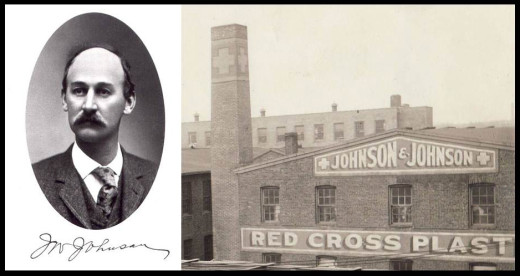
J. Ellwood Lee

J. Ellwood Lee

Rubber bands were often given away to customers by retail druggists.   J. Ellwood Lee, ever an enterprising businessman, saw an opportunity and started packaging cards and boxes of red rubber bands in assorted sizes that could be sold by druggists.  “Jelco” rubber bands, as they were called (the name is a contraction of the J. Ellwood Lee Company name) were advertised as an improvement over standard rubber bands due to their improved elasticity and longevity, a result of the type of rubber used and an improved method of curing it during manufacture.  So as part of the agreement to list and promote each other’s products, in the 1910 issues of The Red Cross Messenger, Johnson & Johnson promoted Jelco Rubber Bands to retail druggists and listed them in its price lists.

1910 Price List: Jelco Rubber Bands

Page from the 1910 Price List showing the listing for Jelco Rubber Bands

(By the way, Lee’s automobile tires were initially also called “Jelco” until automaker Henry Ford objected…because he didn’t want his automobiles riding around on tires that suggested “jelly” to people.  So Lee changed the name of the tires to “Lee of Conshohocken.”)

Published in: Did You Know?, Early Products, Unusual Products | on December 11th, 2008 | 7 Comments »

10 Things You Didn’t Know About J&J

 Office Interior, 1940s

A Peek Inside One of Our Offices in the Mid-1940s


1. The Company started on the fourth floor of an old wallpaper factory.

2. In the Nineteen-teens, before air conditioning, Johnson & Johnson had a swimming pool for employees – at work! — so they could cool off in the summer heat.

3. When he was younger, Robert Wood Johnson the first was known to wear a stovepipe hat.  (We don’t have a picture of him wearing the hat in our archives, unfortunately.)

4. Barry Manilow wrote the “I Am Stuck on BAND-AID® Brand…” jingle.

5. John Travolta, Terri Garr and Brooke Shields all appeared in BAND-AID® Brand Adhesive Bandage commercials before they became famous.

6. During World War II, Hollywood movie star Hedy Lamarr came to Johnson & Johnson in New Brunswick for a war bonds rally.  She wasn’t just a pretty face; she invented a technology that made modern wireless communication possible.

7. We used to make duct tape.  Permacel, the company that invented duct tape, was a part of the Johnson & Johnson Family of Companies until 1982.

8. One of our most recently acquired consumer products, the BENGAY® Pain Relieving Patch, does the same thing that medicated plasters did in 1887 – it delivers pain relief directly through the skin. 

9. One of the founders of Johnson & Johnson (Robert Wood Johnson), the founder of DePuy, Inc., and one of the founders of our McNeil franchise all started out working as clerks in retail pharmacies.

10. We used to own a company that made sausage casings, which evolved from research into the possibility of developing collagen as an absorbable suture product.  Collagen never panned out as suture material, but Devro, the company that resulted from that research, is still going strong.  It was part of the Johnson & Johnson Family of Companies until 1991, when its management bought it out and spun it off. 

11. Okay, 11 things.  Here’s one more as a bonus.  We made a tooth-whitening tooth cream in 1887.

Published in: Did You Know?, New Brunswick, People, Trivia, Unusual Products | on April 30th, 2008 | 4 Comments »

Beauty Spots

Throughout its history, Johnson & Johnson has been known for developing and making products in response to needs in society…such as the first commercially available sterile surgical dressings.  Occasionally, though, the Company produced a product that helped fill a more unusual need in society.  One early product filled not a health care need, but a fashion craze.  And that product was…Beauty Spots.    

Beauty Spots Package Showing Beauty Spots in Use

Beauty Spots were small pieces of material – usually black silk or sometimes velvet – with adhesive on the back.  They were most commonly shaped like small stars, crescents, arrows, hearts or circles.  Beauty Spots were used by women to attract attention to the complexion or an outstanding facial feature, such as the eyes, mouth, or a dimple.  They would stick the product on their faces near whatever facial feature they wanted to accentuate.  Occasionally, according to sources, women would use a number of them at once, which gave them the unfortunate appearance of having broken out in oddly shaped spots. 

Beauty Spots from 1913

In 1915, the Company wrote:

“To supply the demand created by this fashion we have arranged an assortment of designs consisting of stars, crescents, arrow points, hearts, etc., which are put up in envelopes, each containing 100 spots (3 dozen on a card); also in fancy boxes containing 300 assorted.”  [RED CROSS MESSENGER p. 286, March 1915, Vol. VII, No. 10.]

It was typical of Johnson & Johnson that, rather than just putting the product on the market (where it was bought by fashion-conscious women), the people at the Company felt the need to provide some education and background about its Beauty Spots.  So Fred Kilmer wrote about them in the March, 1915 issue of THE RED CROSS MESSENGER, the Johnson & Johnson publication for the retail druggists who sold our products.

According to Fred Kilmer, Beauty Spots were worn in Ancient Rome and Egypt, and there was a beauty spot fad in 17th century France during the reign of Louis XIII, and in England during the reign of Queen Anne.  Kilmer included an illustration from an old treatise on Beauty Spots (shown below) that shows someone wearing a number of them at once, including an elaborate horse-drawn carriage running entirely across her forehead!

 rcmbeautyspotpic.jpg

RED CROSS MESSENGER Reproduction of Old Illustration Showing Beauty Spots in Use

Johnson & Johnson made Beauty Spots out of materials left over from making plasters.  Since 1887, Johnson & Johnson had been making Court Plasters, which had the same origins but were the more practical cousin to Beauty Spots.  To confuse matters, Beauty Spots were sometimes referred to as Court Plasters, a name that goes back to their origins in the royal courts of Europe.  They had been used by court women, who set the fashions in their day.  According to Fred Kilmer, Court Plasters started out as fashion statements, before being used by the masses to cover small cuts and scratches. 

Black Taffeta Court Plasters 

 Colorful Packaging for Arnica Court Plaster

Court Plasters were small and adhesive, and came in little pocket-sized sheets that could be cut to size to cover up a small scrape or cut.  They were made of luxurious materials like silk and taffeta, and came in a variety of colors.  (A tradition that was later continued by BAND-AID® Brand Adhesive Bandages!) 

 img_wound_bandaid_03_pic.jpg

Continuing the Court Plaster Tradition?

Johnson & Johnson also made Court Plasters from isinglass, a material derived from fish scales.

 Cotolia Liquid Court Plasters Ad     Cotolia Liquid Court Plasters

Cotolia Liquid Court Plaster

Oddly enough, the Company also made a liquid Court Plaster to put over small wounds, which sounds a lot like this modern product.  (You will need to scroll down to the second product on the page.)

Fred Kilmer attributed the revival of Beauty Spots to the revival of little “vanity boxes” that could be carried in a purse.  They contained a mirror and could hold small items, such as a sheet of Beauty Spots. 

beautyspots3.jpg

Beauty Spots Packaging, Product and Vanity Boxes

The Company provided educational background not just on its lifesaving products, but on its more unusual products as well, and Beauty Spots were no exception.  Why?  So that the druggists selling the products would understand them and be knowledgeable enough to answer the public’s questions. 


Synol Soap

Synol Soap


Most people today probably use an antibacterial soap at home.  In the Nineteen-teens, before the vaccine era, a germ-killing soap was even more of a necessity to help combat disease and keep people healthy.   Around 1900, U.S. doctors asked Johnson & Johnson to make a disinfectant soap that would help them wash their hands, disinfect instruments, and keep patients clean.  The Company’s response was Synol Soap. 

Johnson & Johnson frequently made products that served unmet needs in health care, such as the first First Aid products.  This philosophy went back to the Company’s first-ever commercial antiseptic surgical dressings in 1887

A 1914 edition of The Trained Nurse and Hospital Review, a monthly magazine for nurses, gives a history of Synol Soap.  

“About fourteen years ago various leaders in the profession requested Johnson & Johnson to establish a formula for an antiseptic soap. These doctors were daily handling all sorts of infections, and required a cleanser not only for themselves, but for their instruments and for their patients. The result was Synol Soap… While Synol is a soap usable just as any other soap, it has remarkable germ-killing powers. Surgeons and nurses use Synol on their own persons, as well as on their patients…”  (The Trained Nurse and Hospital Review, 1914, Boston Medical Library, courtesy of Google Books, page 388.)

 Synol Ad Showing Product in Use

Ad from 1915 Showing Synol Soap in Use

Synol Soap was a liquid antiseptic soap that was sold in a glass jar, and was later made in a solid cake form.  It was an effective disinfectant, germicide and deodorizer, and was mild enough so that it could be used like a regular soap.  It was partially derived from wood tar, which had antiseptic properties.  This gave it a strong smell — something the Company promoted as being indicative of Synol’s disinfecting power.   Ads for Synol in pharmacies urged not only physicians and nurses to use it, but also advised consumers to wash their hands, shampoo their hair, and clean and disinfect their homes with it.  The Johnson & Johnson Scientific Department (headed up by Fred Kilmer) issued health bulletins and circulars that talked about the importance of killing germs and improving public health, a lifelong concern of Kilmer’s.

RED CROSS MESSENGER Advertising

Through its trade publication THE RED CROSS MESSENGER, Johnson & Johnson alerted druggists about the importance of public health in fighting disease, urging them to cooperate with teachers and principals to teach hygiene in public schools.  The MESSENGER promoted “Clean Up Weeks” and designated March, April and May as “Clean-Up” season, in which people would thoroughly clean their houses and clear surrounding outdoor areas – anywhere germs could lurk — in order to help lessen the spread of infectious diseases brought by the warmer weather.  In 1915, Kilmer wrote:  “Disease germs hiding in neglected places about the homes and surroundings are ready to attack.”  (RCM Vol. VIII, March 1916, No’s. 9 & 10, p. 459.)  That sounds alarming to modern ears, but the Nineteen-teens saw persistent outbreaks of infectious diseases such as diphtheria, meningitis, measles, smallpox, typhoid fever, and more.  Continued public and private cleanliness and sanitation were the ways to combat these deadly diseases in the days before there were vaccinations and medications to treat them.

Lister's Fumigators

Lister’s Fumigators

Synol Soap was joined by an array of disease-fighting products such as Camphenol (another antiseptic and disinfectant product), Lister’s Fumigators and the JOHNSON’S® Fumigator.  Fumigators contained a variety of compounds with deodorizing or germ-killing capabilities.  When lighted, they produced a smoke that would help disinfect or remove odor in households or public buildings.  One fumigator, Mosquitoons, was designed to kill disease-carrying mosquitoes.  Its instructions said to light it and leave the house while it worked.  To emphasize that point, the Mosquitoons package showed a pyramid-shaped Mosquitoons fumigator at work in a bedroom, which was littered with painstakingly illustrated dead and dying mosquitoes.       

Mosquitoons Box and Fumigator

Although some of these products seem bizarre today, they played an important part in limiting the spread of infectious disease and protecting public health in the early 1900s.

 Products Used to Prevent the Spread of Flu and Diphtheria

Products Used to Prevent the Spread of Influenza and Diphtheria

Published in: Beginnings, Did You Know?, Early Products, Unusual Products | on October 17th, 2007 | 1 Comment »

Vino Kolafra

Vino Kolafra and Two other Kola Products 

What do Johnson & Johnson and the Coca-Cola Company have in common?  For starters, they were both founded in 1886.   But there’s also something else you might not know:  for a short while, in the late 1800s, Johnson & Johnson made a cola drink.

In an earlier post, I mentioned some of the lesser-known and more unusual products made by Johnson & Johnson in its earliest days.  One of my favorites is Vino Kolafra, which was a tonic preparation made from cola nut extract in a sherry wine base.  It was made by a small subsidiary, the Brunswick Pharmacal Company from 1894 to 1896.   Here’s a Vino Kolafra ad from the November, 1896 issue of, oddly enough, Popular Science Magazine.

Vino Kolafra Ad, 1896

Ad for Vino Kolafra in Popular Science, 1896

Ads and pamphlets of the time referred to Vino Kolafra as “a Remarkable Tonic.”  And it certainly must have been, judging from its recommended uses.  According to the ads and pamphlets, Vino Kolafra was recommended for athletes, bicyclists (cycling was a popular hobby back then, too), for the weak and overworked, for people convalescing from an illness, for those with weak hearts, as a brain stimulant and nerve tonic, for hay fever, to ward off fatigue and relieve nervous strain, as a cure for drunkenness (especially remarkable, considering the sherry base!), as a reliever of melancholia and nervous depression, to give troops stamina on forced marches, and more.  And if that wasn’t enough, it also was said to help sufferers from indigestion, asthma, fevers, sea sickness, migraines, and the flu….and it was an aphrodisiac. 

Here’s a great photograph of two bicyclists drinking Vino Kolafra…from glasses they brought with them on their ride! 

Cyclists Drinking Vino Kolafra 

Vino Kolafra wasn’t the only cola product we made.  The Company also sold Koloid Tablets, Essence of Carikola (which combined cola nut extract with extract from the carica papaya, a digestive aid) and Carikola Tablets.  All of the cola products were marked with a distinctive red pyramid on the label. 

 Kolafra Products, 1890s

Cola Products Range, 1890s 

In addition, the Company made Sparkling Kolafra, which was a carbonated drink made from cola nut extract added to sparkling water.   It was advertised as being superior to ginger ale, plain soda and root beer.  An 1897 advertising book for Sparkling Kolafra recommended it for:

Bicyclists, during long runs
Mountain Climbers, after reaching the top
Ministers, after long sermons
Doctors, after collecting bills
Editors, during excessive mental labor
Base-ball enthusiasts, during the game
Dancers, after two-hours waltzing
[1897 Advertising Book, A Tropical Tonic]

The success of Coca-Cola® and other, less reputable tonics, had fueled interest in tonic preparations in the late 19th century.   The Company responded by investigating the properties of kola nut extract (as they spelled it then) and coming up with products.

Vino Kolafra was discontinued when it was discovered that workers in the plant were also investigating its properties:  they were sampling the sherry base in increasing quantities.  


Published in: Did You Know?, Early Products, Unusual Products | on August 30th, 2007 | 2 Comments »

We Made WHAT??

Along with its more famous products, the Company made some lesser-known and more unusual products in its early days. One of these products was Vino Kolafra, a restorative tonic made from kola nut extract with a sherry base.


Vino Kolafra Ad

The formation of the Coca-Cola Company in 1893 and its subsequent advertising campaigns helped spark interest in tonic preparations among the population of the United States. Johnson & Johnson introduced Vino Kolafra in 1894, advertising it as a calmer of nerves, an imparter of strength, a convalescent aid and as encouraging workers to “do more work with less effort and better results. Vino Kolafra was discontinued when it was discovered that workers were indeed doing more than expected: they were sampling the sherry base in increasing quantities.


Vino Kolafra Bottle and Packaging

Although Mosquitoons would win the prize for most humorous product name, they addressed a serious health concern. Mosquitoons were pyramid-shaped fumigators designed to kill mosquitoes, which were disease carriers as well as pests. Users were instructed to light them and then leave the house. The package reassured purchasers that Mosquitoons would not harm metal or clothing…leaving us to draw our own conclusions about the unintended effects of other pest removal products on the market at that time!


mosquitoons070.gif


One of the strangest things Johnson & Johnson made were Court Plasters, which were little beauty spots made from leftover materials used to make medicated plasters. The Company would take a small amount of this material and make it into stars, moons and other shapes, which women put on their face to accentuate what they considered their most beautiful feature. Pictures of early theater and film actresses often show them wearing beauty spots – which look like moles, but on closer inspection are little stick-on dots, stars and crescents.


Example of Beauty Spots

Published in: Beginnings, Did You Know?, Early Products, Unusual Products | on July 20th, 2006 | No Comments »