Product Instructions You Can't Lose!

There’s nothing worse than losing the instructions for something you’ve bought, especially if it’s something you need to use in an emergency. Some people keep all of their instruction manuals in an envelope or a folder, or in an electronic file, which is fine...as long as they remember where they put the file. But there is a better way, and it was discovered by the creator of a famous product that became part of our product lines over 100 years ago.
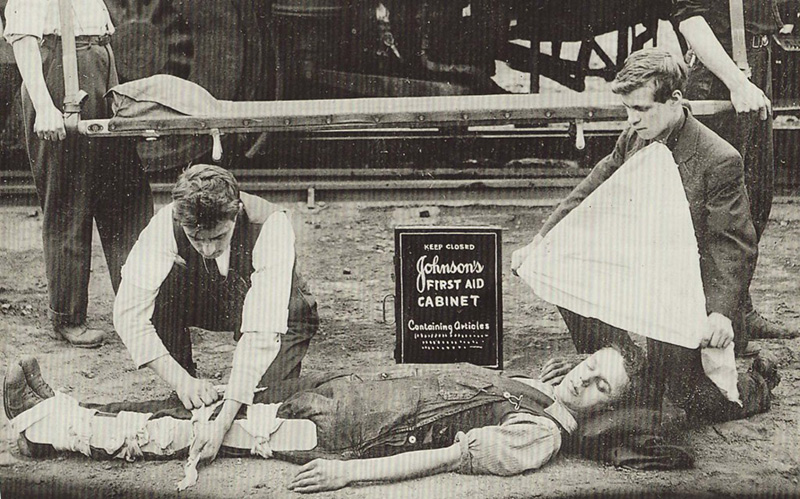
Now where did I put the instruction booklet?
The product was the Esmarch Triangular Bandage, a very well known wound treatment and First Aid product in its day. It was originally invented by Johann Friedrich August von Esmarch, a professor of surgery who had been surgeon general to the German Army during the Franco-Prussian War in 1870. Esmarch was a pioneer in battlefield triage and wound care, and he developed a bandage that could be used in many different configurations to treat soldiers wounded on the battlefield until more medical help arrived, thus helping save lives. He also designed his bandage so that soldiers and medics needing it under stressful conditions didn’t have to search for instructions on how to use it.
So how did the Esmarch Triangular Bandage solve the instruction problem? With a very unusual innovation: the instructions on how to use it were printed directly on the bandage itself. As long as you had the bandage, you had the instructions.
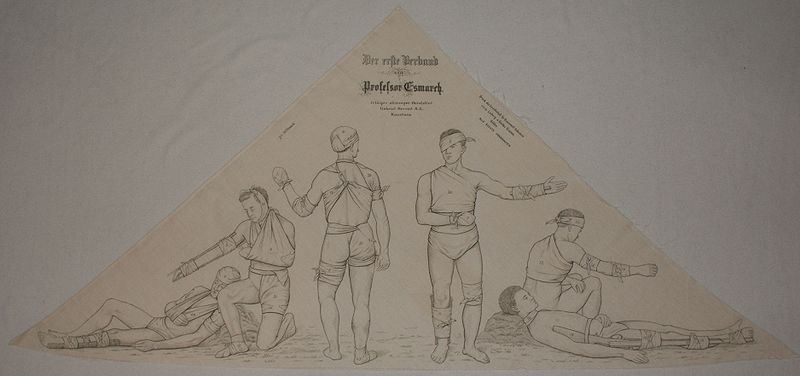
Public Domain Photo of the Original Esmarch Bandage, courtesy of Wikipedia and Wikimedia Commons.
So although we didn't invent it, having earned its reputation as a staple of early battlefield first aid, the Esmarch bandage was added to the Johnson & Johnson First Aid kits – a famous early First Aid product for the first commercial First Aid kits.
The Esmarch Triangular Bandage was a large triangle of cloth, four feet long on its longest side, and almost three feet in length on the other two sides. In the Johnson & Johnson first aid kits it came with two safety pins for securing it in whatever configuration was necessary, depending on the injury and according to the instructions printed on the bandage. A 1903 Johnson & Johnson Handbook of First Aid called the triangular bandage “…the most convenient and the most useful bandage in the world…” [A Hand Book of First Aid, Johnson & Johnson, New Brunswick, N.J., U.S.A., 1903, p. 19]
“The triangular bandage can be used as a sling for any of the limbs; as a bandage for the wounds of the head, chin, ears, face, neck and chest; the back and ribs; the shoulder; the elbow; the forearm and wrist; the hand; hips, thigh, knee and leg; the foot; for the application of splints; the holding on of other dressings; as a preventative and protective, and in fact is adapted to innumerable uses which will suggest themselves. Plain illustrations are printed on each bandage showing the principal methods of use.” [A Hand Book of First Aid, Johnson & Johnson, New Brunswick, N.J., U.S.A., 1903, p. 19]
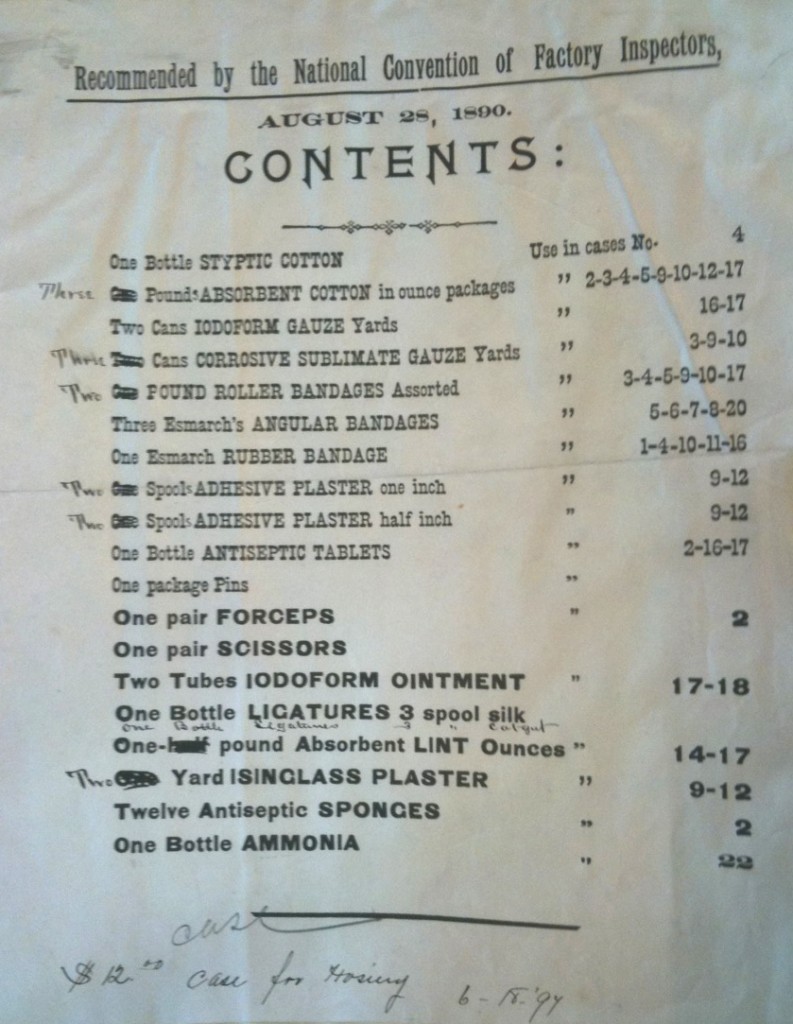
The August 28, 1890 list of contents shown here, for one of our first ever first aid kits, lists three “Esmarch’s Angular Bandages” among the supplies in the kit. Later it was made part of the contents of our First Aid Packet No’s. 2, 3 and 22…which were in turn part of the contents of our larger metal First Aid cabinets such as the First Aid Cabinet No. 1, and the Insurance First Aid Cabinet No. 26.
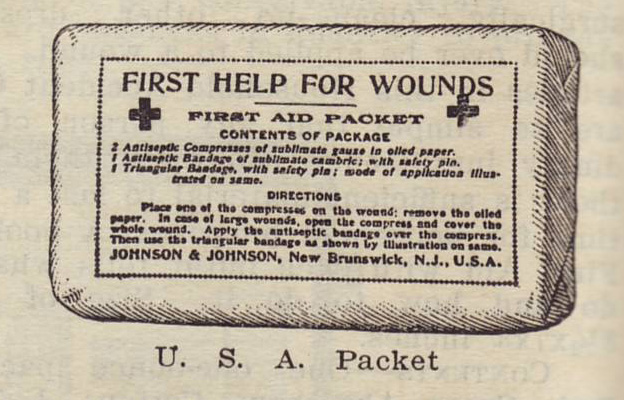
1903 First Help for Wounds First Aid Packet, containing an Esmarch triangular bandage, "method of application illustrated on same."
These First Aid packets were also adopted by the U.S. Army and carried by soldiers…for whom the Esmarch bandage played a critical role.
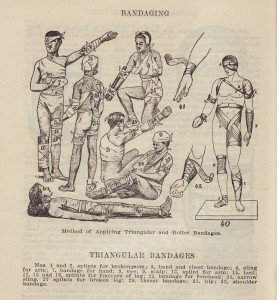
Illustration from the 1903 Johnson & Johnson Handbook of First Aid, showing the many ways in which to use an Esmarch bandage.
And, as readers around the world will appreciate, another very good thing about the Esmarch bandage was that its instructions were visual. It could be understood and used instantly by anyone, in any country or region, no matter what language they spoke. Those universal (and impossible to lose!) instructions ensured that first aid treatment with the bandage could be delivered quickly in an emergency situation anywhere in the world. That made the Esmarch Triangular Bandage one of the most unusual -- and one of the most innovative -- items in the early Johnson & Johnson First Aid Kits.
I have an original esmarch triangular bandage that also has two eye treatments on it. I found it in my ghost town house in Northeastern Nevada, which dates from 1879. It is in excellent condition, never used!
i would like to know about the advertising history of Johnson baby powder.
In reply to by versha gupta
Hi Versha,
We introduced JOHNSON’S® Baby Powder in 1894. For most of its history, the iconic ads for the product have centered on mothers and children. Today, our print and TV ads around the world continue that focus on mothers and fathers using our baby products to care for their children. Here are the links to some blog posts about some of the history of our JOHNSON’S® Baby Powder advertising:
http://www.kilmerhouse.com/2012/05/happy-mothers-day-mothers-and-children-in-our-ads-through-the-years/
http://www.kilmerhouse.com/2009/11/wonderful-mother/
Post showing the earliest ad for JOHNSON’S® Baby Powder in our archives:
http://www.kilmerhouse.com/2010/08/ten-cool-things-from-our-archives/
Hope that answers your question!
Margaret
Please could you tell me when Johnson and Johnson stopped producing the pictorial Esmarch triangular bandages. I have a No. 10 first aid cabinet which has an unopened pictorial Esmarch and also l have one enclosed in the wound pack, and I am trying to date this kit. Also in my country, the United Kingdom, St John Ambulance produced similar bandages at a later date, I believe 1910 to 1920.
Thank you.
Neil
In reply to by Neil Bolden
Hi Neil,
I'm still looking through the information in our archives, but here's what I've found so far. As of December 5, 1955, Johnson & Johnson still included the Esmarch Triangular Bandage in some of our First Aid Kits. So we definitely made the product through the mid-1950s, and i will need to dig deeper in our archives to find more information. If you can send me a photo of your No. 10 First Aid Kit through the blog's email ([email protected]) I will be able to help you date the kit. If it's a black metal kit with gold lettering, it was likely from the early 1900s through 1920s. If the kit has BAND-AID® Brand Adhesive Bandages listed as part of the contents, then it was produced after 1921. How great that St. John Ambulance also produced the bandage -- it was a very famous first aid product!
Margaret
hi, i have too an original esmarch triangular bandage. its an impresionant and very important part of the history of medicine.